
Queen Djenny Djella
Music Is My Truth
Album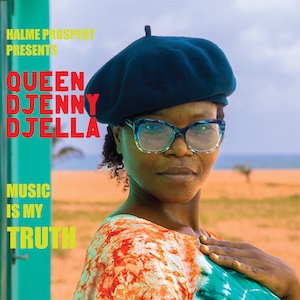
Album information
| Performer | Halme Prospekt Queen Djenny Djella |
| Released | 22.5.2026 |
| Type | LP, CD, digi |
| Players |
|
| Label | Halme Prospekt / All That Plazz |
| Producer | Tuottaja: Hepa Halme |
| Listen |
Biography
This is not just a record. It is an adventure.
The story begins in November 2023 in Grand-Popo, Benin, at the opening of a group exhibition of West African artists at the cultural centre Villa Karo. One of the artists was Djenny Djella, born Djanei Angele Toyisson, who also performed at the event. The performance was arresting. Djenny’s charisma and powerful presence quieted the room. For a moment, it felt as if time had folded backwards.
That feeling was not entirely imagined. Grand-Popo lies in a region once known during the colonial era as the Slave Coast, and from the traditions carried away from those shores grew many of the forms that would later shape spirituals, jazz, reggae, blues and so much of the rhythmic language of modern music. For Hepa Halme, who had visited Grand-Popo many times before and played informally with local musicians, the place had already opened doors into a deeper understanding of rhythm as the foundation of popular music itself. But this time something else happened. A chance encounter became the beginning of a new body of work.
Halme had not travelled there intending to make an album. Nor was he looking for an artistic project in any conventional sense. Yet the apparently accidental meetings of those years kept leading him further into the local culture and closer to its central element, rhythm. When he saw Djenny perform, he understood immediately that he was in the presence of something exceptional. Rather than remaining a bystander, he approached her directly and proposed a collaboration.
At the time, he had on his laptop an unfinished Halme Prospekt track left over from earlier sessions. He had been sketching a new arrangement for it and thought Djenny’s voice might belong inside it.
A session was set up in the kitchen of his temporary lodging with almost no preparation. Djenny listened to the piece once and then delivered her vocal part in a single take, already shaped to the structure of the composition, as if it had arrived fully formed. That recording became their first release together, “Parlez Parlez.” From that point onward, it was clear the collaboration would continue.
There was no need to calculate what kind of material might suit her. It was obvious that Djenny possessed a rare ability to enter music on a level deeper than genre. She could move inside different musical forms without reducing herself to style. From that realization, Halme began shaping a selection of compositions that could become a full-length work, one broad enough to hold different textures, moods and emotional temperatures, yet unified by the inner force of Djenny’s voice.
Only later, while looking at photographs he had taken of Djenny’s performance at the opening, did Halme notice painted words among the white markings on her skin. Across her chest were the words “Music is my truth.” On her right arm, “Death is not the end.” During the final stages of the album, while thinking through the track order and the record’s dramatic arc, those phrases returned to him as central themes. They did not function merely as titles or slogans. They seemed to reveal the emotional axis of the album itself.
As the process unfolded and the artists also began performing together, Djenny’s multidimensional talent and the charge of her stage presence became even clearer. Yet she is not some myth of instinctive naturalness. She is a highly trained and tradition-conscious professional of singing, voice, stagecraft and visual art. Her career as a singer spans more than twenty years. There is discipline in her expression, but never stiffness. There is depth of tradition, but never enclosure.
Her artistic profile perhaps comes closer to the spirit of alté than to any fixed idea of “traditional” African music. That scene, which emerged in Lagos in the 2010s, has been marked by an indifference to genre limits, by strong individuality and by a willingness to let local and international influences move freely through one another. That kind of artistic openness feels close to what happens on Music Is My Truth. Djenny’s expression carries sacred and spiritual resonances, but it also moves lightly across boundaries of style, language and form.
Halme himself grew up under the influence of many kinds of music, though the deepest roots of his own expression lie in blues and related forms. In Grand-Popo he quickly realized that he did not yet know West African music in any deep way. But musical communication grounded in one’s own voice and one’s own expressive instincts turned out to be the most natural way of meeting local musicians and entering the world around him. They were, as he has put it, speaking the same musical language, though with different accents.
That is why Music Is My Truth does not present itself as an “African album,” nor as a fusion project assembled from separate ingredients. It is better understood as an adventure that began with a chance encounter and gradually opened into something larger. At its centre is the soulful voice of Queen Djenny Djella, rising from somewhere deeply interior and carrying with it an unusual sense of presence, trust and transformation. Around that voice, Halme Prospekt builds a sound world that moves between meditation and groove, incantation and song, looseness and design, intimacy and myth.
The album is also a significant point in Hepa Halme’s own musical journey, one that now stretches across more than half a century. Over those decades, he has left his mark on Finnish punk, hip hop, acid jazz, roots-oriented music and experimental contemporary jazz, often at moments when something new was just beginning to form. Founded in 2000, Halme Prospekt has itself renewed from album to album for over two decades, never settling into the habits of a conventional band. In that sense, Music Is My Truth is not a detour from Halme’s work, but a continuation of its deepest instinct: to keep moving, to keep listening, and to allow music to become larger than any system meant to contain it.
The productional core of the album lies there. It is both a document of collaboration and an introduction to a remarkable West African artist of the 2020s, one whose ability to throw herself into different musical situations remains uniquely fearless, imaginative and emotionally affecting. Djenny Djella does not simply appear on these recordings. She alters their gravity.
The album moves through many states. “Akheron” grew out of a long-unfinished Halme Prospekt composition that found its final form through conversations about myth, death and the crossing of rivers known across different cultures. “Mama Africa” transforms an earlier rhythmic sketch into a more lyrical work in which West African pulse and Finnish melancholy meet with quiet naturalness. “Aasheq Bu (In Love),” featuring Marouf Majidi, opens another dimension again, bringing together multiple languages and emotional registers through duet form. “Summernight” carries the magic of a summer night and the freedom of a performance that refused to be trapped by strict formal boundaries. “Bon Bon Bon” becomes a song of praise to life and being, while “Easy Generator” unfolds as a spoken-word meditation on endurance, patience and the price of meaningful things. “If You Think” reaches back to the very first song Halme heard Djenny perform, while “Tango Akheron” and the bonus track “Parlez Encore” complete the album’s circular movement through memory, death, speech and return.
What remains throughout is not a stylistic concept, but a feeling. Music Is My Truth is an album born from trust, from encounter and from the willingness to let music reveal its own path. It is intimate and expansive at once. It is rooted in place, but not confined by place. It carries West African rhythmic intelligence, Northern spaciousness, personal history and spiritual charge, yet never sounds like an academic meeting of references. It sounds lived.
And that may be the deepest truth of the record. Music is not presented here as decoration, nor as a category, nor even as an identity. It is treated as a way of entering the world, of crossing into another person’s emotional reality, and of returning changed.
Tracklist
- Akheron (The River of Death)
- Mama Africa
- Aasheq Bu (In Love) feat. Marouf Majidi
- Summernight
- Bon Bon Bon
- Easy Generator
- If You Think feat. Faarao Pirttikangas
- Tango Akheron (Death Is Not the End)
- Parlez Encore