
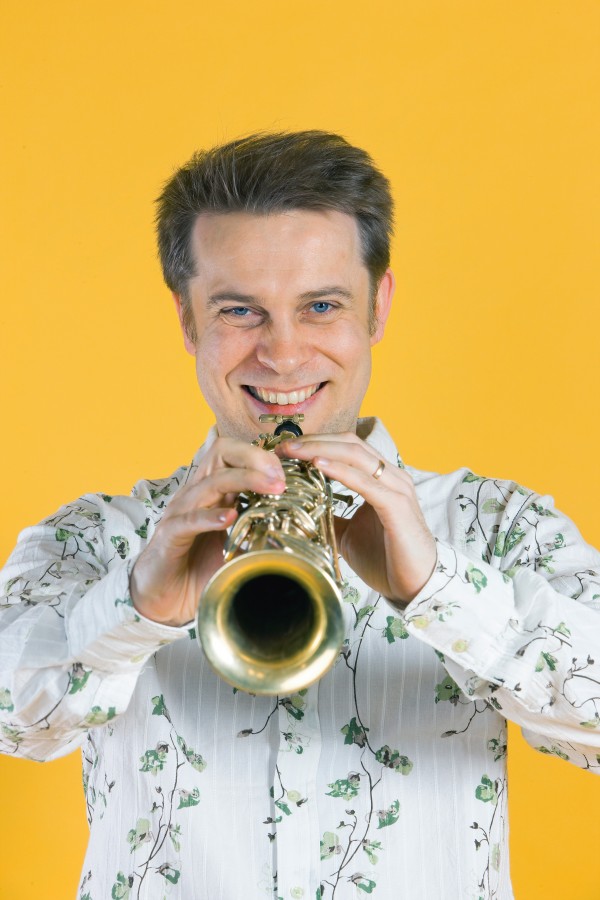
In his opening article for the Jazzpresso article series, Professor Jukkis Uotila tackled the current state of jazz and the potential degeneration of jazz music’s original Afro-American tradition. He aimed his text to the next debater, saxophonist Jukka Perko. Perko takes the floor and provides some echoes and alternative angles for Uotila's ideas that proved hot potatoes in the social media.
In his opening article for the Jazzpresso article series on 31 January, Professor Jukkis Uotila tackled the current state of jazz and the potential degeneration of jazz music’s original Afro-American tradition. As the next debater to take the floor and provide an answer for his ideas that proved hot potatoes in the social media Uotila named saxophonist and pedagogue Jukka Perko. Indeed, in this second article of the Jazzpresso series, Perko discusses what he sees as the polyphonic heritage of jazz music, aiming at opening an alternative angle to the discussion. Perko has also appointed the next writer, whose task will be to give his or her vision of how the separate players in the jazz field could effectively join forces for a bright future. Here is a hint of his or her identity: the person is an experienced musician but also knows the world of production and funding like the back of their hand.
Tentative Ideas Concerning the Fluid Nature of Jazz
Many thanks to Jukkis Uotila for opening the Jazzpresso series and challenging me as his opponent. To me personally, the topics that Jukkis raised in his article are anything but new; in fact, they have frequently cropped up in our private conversations. In the words of a colleague: “Due to the aesthetic and philosophic nature of jazz music, you can debate on these sorts of questions until the end of the world without being able to prove one aspect right and the others wrong.”
This is why I am going to look at jazz from a wider cultural angle, at times bordering upon the very fundamental questions. I agree with Uotila that as a concept jazz has become extremely broad: the word "jazz" no longer signifies a relatively fixed group of characteristics, but functions more or less as a general term or guideline. This can lead to tricky situations when it comes to wholly conceiving of this genre of music that we are very fond of.
However, things would get doubly tricky if we decided to get puritanical about what can be called jazz and by whom. And vice versa, too, for it seems equally unwise to label an instance of music jazz if its creators do not – for one reason or another – wish do so. Even in a very restricted sense, today’s jazz community is so wide and multiplex that it would be impossible to reach a consensus on the criteria of jazz or to appoint the authority or authorities that have the right to apply the term. Consequently, to save energy for something more useful and to preserve what is left of the unity of the jazz field, I believe that it is for the best to accept today’s manifold nature of jazz.
“What will happen to the Afro-American values of jazz music in the future?” That is a good question, Jukkis. My informed guess is that they will not die. Far from it. Perhaps, in the future, they will not be so universally applicable as standards for playing and teaching jazz music as you would have them. Nevertheless, there will always be artists who feel the appeal of this tradition and choose to adopt it.
And Jukkis, who, to quote a colleague, “is the best person to verbalise the phenomena of jazz, so hard to put in words”, and I can only do our part and to pass this tradition on by performing and teaching it.
However, I believe it is out of any individual’s control how much and how forcibly the Afro-American heritage of jazz will resonate with artists and audiences tomorrow. And let it be so. We have to be contented with doing our best and hoping that that will bear fruit. In fact, at this point I would like to express my wish that Jukkis’s unique knowledge as a teacher be more widely available to students of jazz - not only for those enrolled in the University of the Arts Helsinki. Jukkis’s exceptional know-how and tireless encouragement have helped many a young, budding musician – myself included – to excel themselves.
Always a true story
In order to accept the multifaceted nature of today’s jazz, I have always found help in looking at the big picture. By this I do not mean any big picture, but that of cultural transfer. I have learned that for the most part in human history, cultural practices have been passed on gradually in the form of stories by the campfire. Having been told to new generations and translated into different languages, these stories have, naturally, undergone changes.
The implication is that there is no credible way of pinpointing which of these versions would have been the right or the most authentic one. On the contrary, the story has always been as true for those who have heard it at any point in history. It is equally impossible to gauge, when the story would have been at its best – when the story’s golden age would have been – because the future is yet unknown to us. We can always speculate that perhaps the golden age of jazz is yet to come – be the criteria what it may. Even in our modern world this development has not stopped – despite the fact that notation and advanced recording technology allow us to compare the different stages of jazz – but only become more complex.
Certain style or genre might be perceived as more appealing than others, and this often acts as a basis for some artists when they are seeking to form a community with like-minded people. In fact, enthusiasts of the jazz of the 1920s and 1930s have found a good solution to the problem of definition by calling the jazz of this era simply “classic jazz”. As it seems that the term “mainstream” jazz has recently become empty of meaning, would it be a problem to come up with a new term for the species of jazz relying heavily upon the Afro-American tradition in order to distinguish it from other forms of jazz?
New medias – polyphonic stories
Of course the constant cultural evolution does not hinder us from appreciating some version of the story of jazz more than others. In fact, this is what I have myself chosen to do. However, we must be aware that this is a question of taste and opinion, not of right and wrong.
Everyone has opinions that ultimately stem from emotions, and today they are widely uttered aloud in the social media – often without any restraint. New viewpoints are cropping up constantly, but some of them are far from ingenious. To my mind, those who have reached the position of authority in a given community – such as Jukkis – ought to be attended to with care, since we can assume that what they have to give is much more than an opinion. People in this position possess special knowledge and experience that enables them to look at things from a wider perspective and take various variables into account.
It is self-evident to us jazz musicians that improvisation is an indispensable point of departure for interpreting music. We could even call it a method of production. Not planning everything beforehand comes naturally in a jazz performance; some things are left to happen impromptu. This method of unpremeditated act can affect jazz artists’ ways of communication even off- stage. Hence, many jazzers’ opinions can be rather extemporaneous and not always to be taken dogmatically. Many times I have realised retrospectively that I completely lost the red thread or forgot to say something essential in an interview. And when I read other artists’ interviews I pick up on certain things, ignore others. My perceptions are coloured by my interpretation and by what I decide to focus on at that particular moment.
Also, not everyone is capable of quite getting to the root of their own ideas or articulating them in a structured manner. One may be describing a dream, rather than reality. Another might have hidden motives that he or she is afraid of acknowledging. Of course, some people are the very opposite: some people weigh their views very carefully and express them with a remarkable lucidity – people like Jukkis Uotila. It is not reasonable to think that everyone would act or even want to act in a same way. What we need is understanding and genuine tolerance in the face of differences; we need to think that, ultimately, we will gain rather than lose.
Fragmentation of jazz is the price that we have had to pay for this sort of cultural evolution and creative gains, it seems to me. However, I believe that a tendency to regenerate quickly has always characterised our preferred form of art due to its relatively young age. Today’s exponentially increased individualism and new technologies added, no wonder that jazz has taken many separate courses rather than one.
It is futile – especially in a top-down direction – to try to limit the Western modern man’s creativity, curiosity and desire to experiment. In fact, this can be seen as a prerequisite of development: what once was restricted no longer is. It has been proven that not every attempt at crossing the tradition of jazz with a national music heritage has been successful or resulted in remarkable new music. This is natural when we allow creativity to follow its own course: when we are reaching for something new we may lose something old and good and there is no guarantee that our efforts will pay back amply or at all – especially if we try to gauge the outcome of our creative input based on outmoded criteria and values. We are not the first generation to experience anxiety in the face of change, and we should not think that jazz is an island, beyond the reach of change.
Will we immerse ourselves in one story or browse through several?
During the past ten years I have marked that many of my students and some of my colleagues explore the music offerings available on the internet horizontally and often at a very fast pace. This eclectic approach might be inclusive but often less inclined to delve upon its object extensively. Undoubtedly, long-term concentration on a restricted object is not in keeping with today’s intense lifestyle, but this has often made me somewhat indignant: why cannot young people concentrate on anything these days? But on further consideration curiosity has got the better of me, and made me consider the assets of this new approach.
As a student, I used to immerse myself in bebop and Parker, excavating deep into the roots and bedrock of jazz. As a result of my studies I could produce a narrow but detailed specimen of jazz where all the periodical layers were represented vertically, but nowadays the youth’s approach seems to be the opposite: they do not dig in a limited area, but move horizontally and often not only to one, but several directions. When all these influences are gathered together, they make a very different specimen from mine in its heterogeneity but as large – only in a horizontal direction.
I can reasonably be of the opinion that the layers that we find in this latter approach constitute shallower or perhaps more arbitrary specimen of jazz than mine. This approach may also be easily subject to the populism that Uotila mentioned in his article. Nevertheless, I must own that this new approach offers a striking and a strikingly versatile number of building blocks that make the music perhaps better adapted in today’s world. Shallow or not, this approach may also create paths to new musical spheres that, in turn, will be examined in that meticulous, vertical manner that I am a proponent of. Time will tell.
I love bebop better than any genre of jazz and wish to cherish its heritage. However, when I perform my compositions for the novels of Antti Hyry with my group Avara and Hannu-Pekka Björkman, my sound carries very few – if any – markers of my love of and reverence for Parker. But it is there, it is present in all my doings, since Parker happened to change my life and transform my views about music when I was young. How could it be absent? But, if a listener only knows me from my music for Avara, my traditionalist roots might completely escape him or her. Another listener might find, after hearing me play with my group Jazztet that focuses on jazz standards, my keen interest in hymns and church music in conflict with my tastes in jazz. Sometimes it simply is impossible to tell an artist’s favourites and objects of reverence from outside.
Why do I, then, want to divide my energy between two genres instead of focusing solely on Parker’s tradition if that is what I love best? To give an exhaustive answer is impossible, but I believe that this has something to do with me not being made of solely harmonious but contradictory ingredients. A certain genetic ancestry, family and the cultural background of the Finnish countryside, including its religious life, all live within me and make me who I am, for sure. Here I have not had a choice. What has also affected me is the fact that people rarely used to pay attention to me unless I did something special. On top of these factors, I have, naturally, been moulded by things that I have come by either by chance or achieved through conscious effort, such as jazz, Charlie Parker and a membership in Dizzy Gillespie’s big band.
At one point I gave myself an absolution for not being able to distil all these influences into only one kind of music. For someone else it might be possible, but not for me – not quite yet, at least. This has taught me to understand people who are still – for some reason or another – searching for their one truth in the wide world of music. I truly believe that it is only through trial and error that we can find our individual strengths, and this, in turn, I find, is the steadiest basis for substantial musical expression. Like Charlie Parker said: “It’s just music. It’s trying to play clean and looking for the pretty notes.”
Who is out there to hear, to listen, to understand?
Some time ago, I had an interesting conversation with a composer of contemporary music. He deplored jazz artists’ habit of playing long solos and expecting that the audience will have the patience to listen to and concentrate on them. In his opinion, jazz solos – I do not know which performances had given rise to these judgements – appeared trivial straying from the point and outright waste of time from the viewpoint of the listener. He thought that it was respectful of the listener and music itself that every note be weighed carefully instead of churning out on the spur of the moment. This made me somewhat baffled. I could have come up with such counterarguments as “perhaps the artist in question was not a professional”, “what if you were not at your most receptive” or “maybe you have not familiarised yourself with of the idiom of jazz improvisation enough to judge it correctly”. I decided to look for an answer elsewhere.
After a moment’s consideration, it occurred to me that perhaps improvisation embodies one very central element of jazz; searching. I realised that, to me, it is important to have a licence to search for one chorus after another, fail and search again. It means living in a place where one does not have to worry about the stress of time, profit responsibility or risk analyses. This is why I want to encourage my students and colleagues to make mistakes; to not be afraid of them, but to learn from them and get back to the saddle again. As much as I love swing, Coltrane’s raw and compelling sound and Cannonball’s unerring sense of time, I find these essentially human skills worthy of cultivating and sharing through jazz. So, if the idiom of jazz calls for changes for a wider spread of this dialectic of erring and learning and, through it, growing as a human being, you will not find me standing in the way.
“Seek the company of those who are searching for the truth, but avoid those who have already found it”
(said, reportedly, the Czech writer and politician Václav Havel. The origin of the maxim is, however, unclear. It has been attributed to Goethe, Proust and Voltaire, while some claim that it derives from ancient religious texts. Again, this tells something about how the story evolves and how it affects definitions of the truth.)
As to what Uotila said about jazz and art in general opening up in all their nuances only to a limited group of people I understand and agree with. However, I do not think that we should draw up a list of requirements for those interested in our art. It should, essentially, be open to all, despite the fact that perhaps not everyone catches every little detail that we have endeavoured to invest it with. Where I also see eye to eye with Uotila is that substance should always come first: whilst welcoming all friends of jazz, we should also look tirelessly for new, challenging, even dangerous paths of musical expression.
A high level of substance and today’s approaches are not mutually exclusive in the hands of a professional. Keeping our finger on the pulse and making use of today’s rhetoric, our music will be more approachable to those who are interested in but not experts of jazz. I think that we can find an exemplary way of reconciling these two aspects in the activities of the collective We Jazz. They build their concerts around a concept and always spread the word actively. In the end it is enthusiasts – not experts – who buy tickets to our concerts, our recordings (albeit decreasingly) and decide on the public funding of the arts and jazz. We need to find those people among us who can speak for our unique art form with eloquence and passion to carry the flag of jazz.
However, I find that turning to elitism would not be to the purpose here; on the contrary, it might only introduce the problematic connotation of “us and them” into the discussion. Instead, I would rather speak of jazz as marginal music which lives from a healthy disregard for any restraints, elitism included.
Together by the campfire
In this article, I have repeatedly alluded to the fragmentary state of today’s jazz field, trying to explore some of the reasons. I have also endeavoured to demonstrate why there is no turning back to what once was. In addition to myself, I now want to challenge the next polemicist to ponder on the shared values of our colourful community. What is it that keeps the jazz field together today? Why is it worth it to become a jazz artist or a jazz enthusiast? What are the factors that make jazz music stand out from other dozens and dozens of options that people have to choose from today?
It seems that students of jazz are, on average, dutiful and responsible people, but should there be more space for noncompliant and boldly self-reliant approaches to making jazz? Is jazz a uniting or a dividing force? These questions have become all the more important today, when jazz enjoys respect, yes, but not the privilege of being allotted a lump sum of money regularly to fight over among ourselves. Today the fight is much wider in scope, since we are increasingly competing with other subfields of arts and culture. To my mind, we artists would do well to overcome our occasional sensitivity and be prepared to give accurate and well-founded answers to the abovementioned, even slightly disconcerting questions. This is how we can connect with those who question us and get a chance to justify our cause. Nor ought our community to be discouraged by its few disillusioned members, but pull on the same end of the rope.
In the future, we should be able to refer to studies and produce figures, too. Even if we doubted science’s effectiveness to reveal the deepest essence of jazz, a call for research in our field evidently exists. One area that strongly speaks for the uniqueness of jazz, I think, is that of co-operative skills. Being capable of quick and intuitive decision-making as a team, without a premeditated aim, the jazz group represents, to me, one of the most interesting forms of teamwork.
We know intuitively that our beloved jazz music is needed in its all forms, but not everybody feels the same. This is why it is us who will have to take the first step.
Text: Jukka Perko Editor: Raisa Siivola Translator: Annamari Innanen