
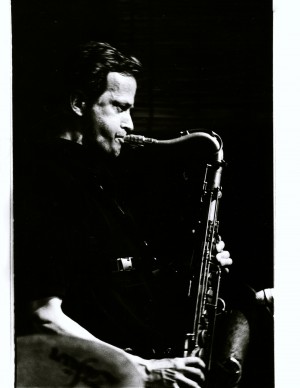
Saxophonist Jorma Tapio has been called as the "outlaw of Finnish jazz". In the new Jazzpresso edition Tapio explores the concept of expression and finding a true sound.
Original text: Jorma Tapio
Translation: Anna Innanen
Of the Force of Musical Expression
When you catch only a few of seconds of music it is the sound that you will remember. It either moves you or it does not. The most important element of music is the sound, and not any kind of sound: it has to be human; it has to be unique to make a true impression.
Expression
What is it exactly that the musician or composer seeks to express about life? What kinds of stories; what sort of energy; which emotions? Is it only a few notes of truth after a careful build-up or a massive, hypnotic onslaught of energy by means of which the artist seeks to form a communion with Omnipresent Energy? When in front of the audience, the artist has to risk everything; unveil him or herself to the bone. One has to have faith in one’s instincts; give one’s innermost impulses free rein; ignore the pull of all external forces, norms, and fashions. Playing pretty notes is not enough.
Ornette Coleman said that he felt naked on stage; Don Byas saw his sound as a protest against injustice. For John Coltrane musical expression equalled praying and, indeed, he approached improvisation as a form of meditation. Ben Webster, Miles Davis and Edward Vesala revealed their tenderest sentiments in their slow ballads. When the artist expresses the truth from his heart, any emotion – be it something fragile and intimate or something raw and powerful – will inevitably come across and reach the open-minded listener. This kind of playing consumes much more energy than emotionally detached, academic playing. Energy equals emotion, and emotion can only come from the heart.
Power
The lifeblood of expressional power is will. A will to express something important; a will to give something to others; a will to act as a mediator. Coltrane said that it was an artist’s spirit and willpower that always struck him the most. The sound is, of course, an essential element of expression. To be potent the sound must be earthed; in other words, one must let the whole body resonate. To allow this, the body must be open and relaxed; the energy must be free to flow. The hip must to be in a correct attitude and the torso free from tension. Unfortunately, one often sees tightness of the torso in artists today – perhaps due to excessive sitting. This results in neurotic, shallow energy.
Fashion is also to blame: a tidy, feathery sighing seems to be the vogue in singing today; horns are played lightly. It is technique and various gimmicks that are the thing today, instead of learning to fill each note with such energy as to make the ground tremble. Today’s approach impoverishes the sound and diminishes the healing power of music. The best musicians are able to touch in a comprehensive way – touch the mind, the body and the soul. When it comes to drumming, neurotic energy that hurts the ears is the sign of a wrong technique and it shows itself when the instrument is played loud. This is far from the famous snare tremolo of Art Blakey, which, as the story has it, made the glasses of the restaurant chink; or from the majestic thunder that Edward Vesala was capable of conjuring up on his drum kit.
History
Music teaching should delve into the history of sound. It should explore how it was that David Oistrakh, Don Byas and Gene Ammons were able to produce such an exceptional sound on their instruments. Throughout the history of jazz, many artists have extended the scale of expression by departing from the system of equal temperament. Pioneers include alto saxophonist Jackie McLean and trumpeter Booker Little, both of whom resorted to blue notes for more emotion. When playing in r’n’b groups, Ornette Coleman noticed that playing certain notes “out of tune” on tenor saxophone was able to make even the most dedicated rednecks of the Deep South dance in a frenzy.
Eric Dolphy was fond of the tones X, Z and K, which fell between the scales. Albert Ayler went one step further by focusing on sound alone – sound which rang numerous tones. There will always be purists; musicians that choose to restrict their expression to narrow, orthodox limits. But when one ventures outside of this academic sphere, one finds oneself in a realm that abounds in rhythms, harmonies, scales and other tools that are just waiting to be adopted by someone bold enough to take up the challenge. It is a rewarding world, full of the excitement of self-discovery!