

Jazz Finland’s annual membership gathering Valtakunnalliset Jazzpäivät (“National Jazz Days”) took place at Tampere Jazz Happening festival in what seems to be today’s spirit: The half-full Pakkahuone followed the Yrjö Award ceremony and the award-winner's show with masks on. However, the event was streamed, and you can watch the video free of charge here: https://tiketti.stream/fi/stream/72237. This year’s Yrjö went to saxophonist Timo Lassy, and Jazz Finland’s life’s work award Andania to journalist Matti Laipio. In this interview the laureates look back into the Yrjö history, and the Finnish jazz today.
The Yrjö Award is an annual jazz prize given to a Finnish jazz artist in acknowledgement of their outstanding contribution to Finnish jazz music. The award was launched in 1967. This year’s winner is saxophonist, composer and band leader Timo Lassy. The award jury placed Lassy among the nobility of Finnish jazz, and praised him for reaching out to audiences beyond the jazz-lovers. How did it feel to receive the award, especially this strange year, Timo Lassy?
– It is a tremendous honour to be awarded! Now that the Happening features only domestic artists, it is exceptionally great to be able to play in Tampere with not one, but two ensembles, says the saxman.
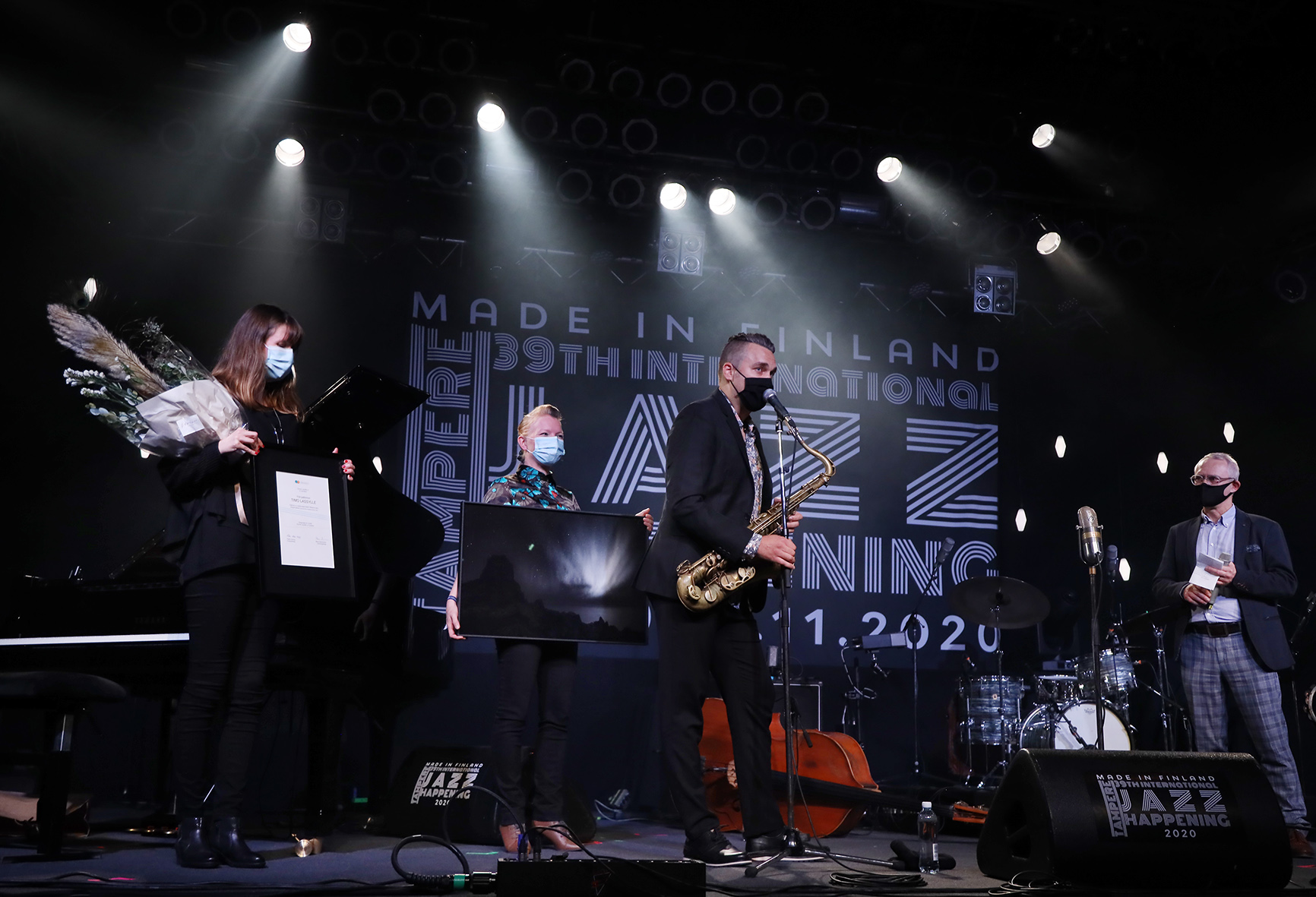
Photo: Timo Lassy receives the Yrjö award on Pakkahuone stage.
The Andania Award is occasionally granted by Jazz Finland to a person or a group for long-term, perseverent work for the promotion and establishment of Finnish jazz music and culture. This year the recipient, journalist Matti Laipio, also happens to be the creator of the award itself! Laipio, who has made a long-term career in jazz journalism and promotion, has also been the Chairman and a member of multiple Jazz Finland’s Boards in 1970–1990’s. You were the Chair during the first Andania; what’s the story behind the Andania Award, Matti Laipio?
– In the spring of 1988, Chrisse Schwind [the drummer of DDT Jazz Band] called and proposed that the jazz federation would award the DDT Jazz Band with Yrjö, in celebration of their 30-year anniversary. I said it’s not possible, because Yrjö is always given to a single musician. Then I took a moment and continued with an idea to create a new award to pay honour to this kind of dedication. That’s how the proposal for a new recognition got presented to the Board, and the first Andania was awarded to DDT already in the fall of 1988, Laipio recalls, and adds:
– It’s truly nice to realize, that my long-term work is recognized with such a wonderful way!

Photo: Matti Laipio with the Andania award on stage.
The prize is named after the Andania ship, on which jazz music allegedly arrived in Finland in 1926. Jazz Finland, formally known as Finnish Jazz Federation, was founded in 1966 by a group of musicians, and the first Yrjö was given to Eero Koivistoinen at the first edition of the “National Jazz Days” already in 1967. Matti Laipio, one of the “voices in jazz” in the radio in the past decades, summarizes the beginninng of the Finnish jazz history in short:
– The first actual jazz generation emerged around the time that the federation saw daylight, in the mid-60s. Before that, the musicians were mainly dance musicians who also played jazz. This new group featured such names as Eero Koivistoinen, Heikki Sarmanto and Edward Vesala. They also quickly reached international levels, Laipio says. Timo Lassy adds that the likes of Koivistoinen and Juhani “Junnu” Aaltonen (Yrjö-awarded in 1968) also sparked his interest in jazz in the 1990s.
– The first circle of modern-era musicians grew little by little until the 1980s. The actual big bang happened in the late 80s, when more and more musicians graduated from Sibelius Academy, with better and more versatile education. For them, internationality was self-evident in their studies and work, Laipio describes the next generation in FInnish jazz. Out of this wave’s artists, Lassy mentions Severi Pyysalo (Yrjö in 1988) and Jukka Perko (Yrjö in 1989) as a few, who inspired him.
Lassy himself graduated with Master of Arts from the Sibelius Academy in 2005.
– Music and sax playing started to become more of a profession to me in the brink of the new millennium, says Lassy.
– I can say I was extremely lucky to grow alongside the very generation of Finnish jazz musicians who made their debut in the early 2000s, he continues. He and his peers indeed rode the next wave of Finnish jazz. There’s no doubt in Lassy himself being an influencer to many young jazzers in 2020, due to the membership in the two groundbreaking bands that brought jazz back to the clubs, and people dancing to its beat: U-Street All Stars and The Five Corners Quintet skyrocketed in Finland and abroad in the dawn of the millennium, and gave a headstart to Lassy’s solo career in 2007.
Lassy and Laipio agree that Finnish jazz has taken a positive turn during the latest decades.
– It has been a pleasure to follow this immense development. Let’s hope that the fair winds keep blowing. Currently Finland boasts with top-level jazz musicians, many of whom are absolutely world-class players, Laipio praises.
– And more and more artists also have the opportunities to an international break!, adds Lassy.
– The artists and the real audience have come closer to one another, and many musicians are now more outgoing. Today, digging jazz is more popular amongst the younger generation: music is enjoyed without genre borders and it’s played also outside the traditional jazz festivals.
Yrjö Award has once again hit the target in quality and topicality. Unfortunately, the pandemic has taken its toll on Timo Lassy’s live calendar, but maybe the 2020 live album comforts the Lassy fans in the corona season. On the Big Brass (Live at Savoy Theatre Helsinki) album Timo Lassy Band is featured by the impressive Ricky-Tick Big Band brass section. At the Tampere Jazz Happening Lassy’s band plays live one more time, on Sunday, Nov 1, at 6.30pm at Pakkahuone. The concert is also streamed live.
Text: Raisa Siivola.
Photos: Maarit Kytöharju.