
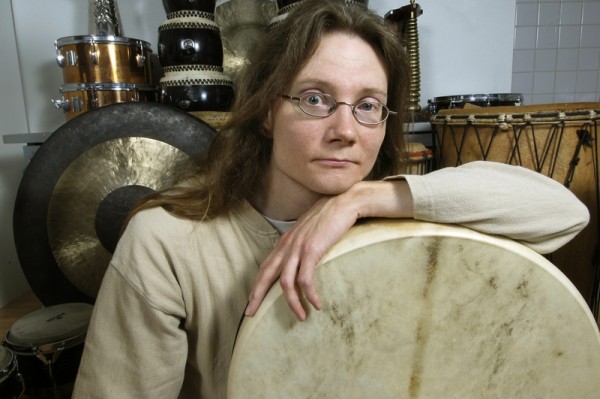
What is jazz? What is improvisation and inspiration? Classically educated drummer, percussionist Janne Tuomi is a frequent visitor in various jazz occasions, but doesn't want to be labelled a jazz musician.
Text: Janne Tuomi
Translation: Anna Innanen
Does it swing?
It has been with great interest that I have read the Jazzpresso article series and the debate that it has sparked. However, in many ways I have felt that I am somewhat an outsider to that debate. I am neither a Helsinkian nor an alumnus of the Sibelius Academy; I have trained mainly in classical music and performed mostly with symphony orchestras or chamber ensembles. Despite having gigged with different sorts of improvising groups on numerous occasions, some of them have been a far cry from traditional jazz.
“How dare we spend so much valuable energy answering such questions as ’what is jazz?’” I could not help the point made by New York-based bassist William Parker from springing to mind once or twice when reading the past articles. I believe that most musicians want to play the best kind of music, but what is ‘the best kind’ to each of us is surely a more complex question with as many answers as there are debaters. It is the pedagogue’s task to ensure that students acquire the knowledge and tools that they need in order to become creative artists, capable of standing on their own feet. That is an important debate, worth going on; just like those on internationalisation and the role of jazz in today’s world. Each of these have been discussed by past writers in the series. In the present text, I will be concentrating on the music itself, reflecting on this vast topic from the viewpoint of openness as challenged by Petri Silas. I hope to illuminate the question by laying an emphasis on one of the most elemental parts of jazz: improvisation. What follows will be a handful of personal observations; thoughts stimulated by the past Jazzpresso-writings.
Live in the now
Music is expression. Improvisation is questing for new; living in the now. Is the Bach played by the Modern Jazz Quartet jazz or baroque? Well, at least it was a commercial success. Was I a jazz musician when I performed with Jukka Perko at the Pori Jazz Festival? I do not think so because it was hymns that we played and because I was a part of the accompanying sinfonietta, with Perko being the only one with the freedom to improvise.
Since Charlie Parker’s times, some jazz artists have always been blamed for corrupting jazz. That is what happened to bebop artists when they, refusing to be ‘minstrel men’ or entertainers, moved away from the danceable swing. On the other hand, Thelonious Monk called all music dance music, and I have come across the same definition in West-Africa: music is good if it makes people dance. If people do not dance the message is clear: there is something wrong with the music. The music of John Coltrane was at the time condemned as ‘anti-jazz’ by some; not to mention the fierce criticism that the likes of Eric Dolphy and Ornette Coleman drew from people that had made it their business to define what is jazz and what is not. Charlie Parker sought composition classes from Edgar Varèse but, sadly enough, he died before the commencement of the studies. The maestro Varèse was not interested in improvisation before meeting Parker, but even though his piece “Poème électronique” is influenced by the Bird it does not really sound like jazz. One of the last albums by my own teacher Ed Thigpen’s trio is entitled “It’s entertainment”. He never considered himself as an elitist; he can be chastised neither for neglect of swing and tradition nor, on the other hand, for creative aridity.
Does it swing?
Does it swing or not? What is swing? Elvin Jones has probably provided the most generic definition: “Swing is like bear shitting in the woods. Bear shit. Shit jazz!”
My recent move to Berlin has brought me into contact with the local jam session scene. Here, too, one finds players of a diverse level on stage and the repertoire consisting mainly of jazz standards – with perhaps an odd reggae tune thrown in. Once at a club, the bassist of the house band – clearly an old hand, capable of keeping any song together, only his facial expression indicating when he was unhappy with the drummer’s performance – cut in on a young rapper, utterly stealing the show with his frenzied, extempore dancing and rapping. If that was not freestyle, living in the now, then what is? Max Roach himself predicted that the next Charlie Parker would emerge from rap circles. I cannot say if such a messiah has been found or if it even matters, but what does matter is that Roach did not want to shut out the genre of his musical sphere.
Inspiration in curiosity
When I am playing and learning music I never spare a thought for the names of the genres. Instead, I try to grasp the very core elements of a given genre; the elements that make a given genre what it is. Often they bear a relation to the times, the personalities of creative people, the circumstances, nature, the ways of life. Where was the genre born? How did people live at the time in that place? What kinds of soundscapes were they surrounded by? What sort of a society did they live in? What did they value in life? How was their aesthetic heritage like? What sort of instruments did they have at their disposal? What kind of an aesthetic heritage did they have? These are the kinds of questions that I ask myself to be able to express messages – even invent new ones – as a professional artist. Despite the surface differences in messages and in the ways they are expressed, the meanings that they carry are often essentially similar around the globe: at the core people are not so different. Certain things keep them alive; make them happy or sick; cause them trouble. I am more interested in similarities than dissimilarities. When playing I strive to express the idea, the spirit of a given music. The more I can and know, the freer I become as an artist.
By listening to recordings, watching videos, poring over sheets, reading biographies and, of course, playing, it is possible to travel back in time and visit different worlds, emotions, thoughts. When it comes to music I have always been extremely curious to try anything new. How thoroughly I delve into a given genre may depend on numerous factors but there is no genre that I would close out without exploring it. Because the public debate on issues raised by the Jazzpresso articles seems to have waned, I would suggest several contributors for the next text. I challenge Jorma Tapio, Linda Fredriksson and Harri Sjöström – all extremely creative saxophonists in their way – to share their thoughts, in dialogue with each other or individually, on, for example, the power of expression.