
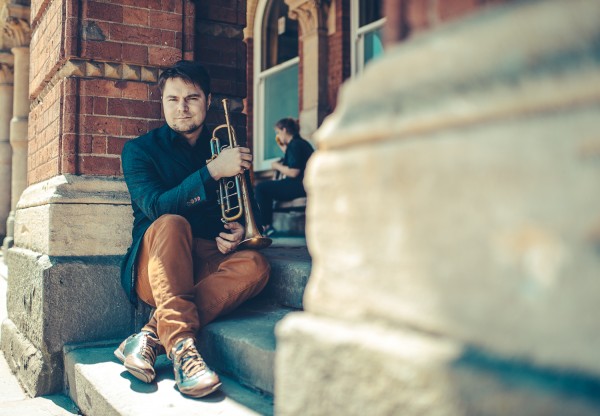
Verneri Pohjola, the fourth contributor to the Jazzpresso article series, shares the twists and turns of his career as an international jazz artist. Pohjola highlights that especially in the 2010s it is impossible to give definitive steps to international success. Instead, he believes that a key to success may lie in two skills: the ability to count on one's artistic vision and the readiness to adapt to the changing nature of a jazz musician's profession.
The previous Jazzpresso writer Jussi Fredriksson challenged me to write about internationalisation from the point of view of an individual artist. I would like to thank Jussi for the honour, but in the same breath I have to add that it is difficult to offer any one definitive way to tackle the topic. Now that big record labels are struggling financially, fool proof recipes for international success may be beyond our reach. Despite this obvious hardship, I am happy to share what I have learned about this elusive question so far.
At First the Band Came First
The very first gig that I played abroad was with Ilmiliekki Quartet in the Young Nordic Jazz Comets finals. It took place in Oslo; the year was 2001. Before the concert we took a turn about the city with our Finnish hostess; apparently, she was committed to show us round all Oslo. I was not quite so keen on sightseeing since there was a bunch of butterflies fluttering in my stomach. Of the actual show I remember nothing but I was probably disappointed with my own performance whilst being proud of our artistic vision. At the time I believed in us unflickeringly; if we could only gain the approval of the critical audience the world with its great venues and renowned festivals would be ours.
The reality proved somewhat different. After a few years of extensive gigging each of us had started to make a new for himself. At that point Ilmiliekki Quartet ceased to come first; it became only one among the many groups that each of us were involved in. As a consequence, the number of gigs that I could get outside the Finnish borders reduced even though I was perhaps best-known of the members. I was, however, also the only one of us who did not have a career plan independent of Ilmiliekki.
From the Shelter of a Group to the Limelight
It is often the case in the world of jazz that a solo artist’s name carries more weight than that of a group. Despite this fact, I used to be convinced that I would make my career in a band – in fact, the whole idea of asserting myself as a solo artist made me nervous. But it having dawned upon me that by writing solo material I would have a wider variety of opportunities for playing live I ended up making my first solo album, Aurora. Indeed, Aurora acted as a counterweight to the tight-knit group spirit of Ilmiliekki. What intrigued me was the flexibility that solo material allowed: I could tailor the line-up according to the situation and, thus, conveniently evade the jigsaw of musicians’ schedule overlaps. This was perhaps my first insight as to how to increase my job opportunities without any damage done to artistic integrity. Arranging my compositions to changing line-ups, however, proved both taxing and time-consuming and so one of these line-ups became established as Verneri Pohjola Quartet.
Countless jazz bands around the globe are named after their leaders, and it is not hard to understand why. An artist who makes his or her career under their own – and not a band’s – name has the asset of flexibility on their side: it facilitates making use of networking and seizing job offers and makes appearing as a guest artist much easier. As to myself, working under my own name swiftly started to bear more fruit than I would have expected. And, to top it off, the album Aurora was received well by the music media.
Going international – ACT one
It all started when Siggi Loch of ACT contacted me. He was interested in releasing Aurora – on condition that I would sign a five-album deal with the label. I was exhilarated. It was happening! People would see what fine music I make here up north with my colleagues. It seemed to me that the one moment when things start to go right was at hand. And a deal of good things did happen: Aurora was lauded in the European press and I got to appear on other albums published by ACT and to meet and play with a number of European artists. My band even performed in Germany a few times.
Too much pressure – too many writer’s blocks
I was told to start writing another album right after the launch of Aurora. I was to compose for quartet again and the line-up was to be the same on the album and on tour. I would have six months. Despite the fact that I felt that I was not given enough time, I agreed. Ancient History came out – as scheduled – exactly one year after the German release of Aurora, but it failed to live up to the expectations. Indeed, Siggi Loch said that Ancient History did not compete in Aurora’s league. But how could it have when there had not been enough time to trim it and hone it?
What followed was an almost two-year break before the record label showed any interest in my doings. When my inquiries with regard to the third album were not replied I was seriously anxious to find a way out. In the end, I was suggested to make a tribute album to Louis Armstrong since it would be a safer way to get me on tour than another album of originals. In spite of my passion for Satchmo’s music – or due to it, perhaps – I did not find the idea viable. I replied that I saw releasing my own music as the best way to further my career. That was when my career as an ACT artist came to an end. The difficult decision, however, contained the seeds of a new phase of intense artistic productivity.
It did not take long for me to realise that the tough decision had been the right one. Soon after the dead-end with ACT, I met Dave Stapleton of Edition Records at the We Jazz festival where I performed. We had a chat and I happened to make a reference to my current situation. A month later, I had entered into a recording deal with Edition. This time, I felt that I was in better control over my music, and this confidence soon manifested itself in writing and rehearsing sessions: within three months I had composed a good deal more than in the past three years.
This inspiring atmosphere – coupled with the brilliant musicians that I had the privilege to work with – enabled me to make what I consider as my best album so far. I am immensely glad that I have the opportunity to make jazz music with Finnish musicians in Finland, release it on an English record label and perform it on the continent.
No one can stand straight alone
What have I, then, learned about internationalisation and gigging abroad? For one, that it requires making effort every day, in the same way as rehearsing. One has to find the right hubs and links and these cannot be forged on the world wide web. To create enduring networks is bound to take time, since one has to go where the real people are.
To keep the wolf from the door, heaps of independent labour is still a necessity for a jazz artist. The nature of the job has, however, undergone so many changes in recent times that it is hard to keep up with them. nowadays, it seems, our job description entails much more than just composing and performing music but, luckily, there is plenty of help and education available as to these other aspects: in Finland, such bodies as Music Finland, Teosto, Finnish Music Foundation and Sibelius Academy offer plenty of support of various kinds – one simply has to seek it. Also, it is vital that one is willing to recognise one's weak points and actively adopt the means of improvement best suited to him or herself. At JazzAhead in Bremen, German bassist Dieter Ilgin perceptively pointed out that requirements related to marketing and promotion vary since each artist is different. He even stated that some artists find it insurmountable to promote themselves, which ought to be taken into account by associations and commercial players in music business.
Passion is at the heart of it all
I believe that an artist should make the music that he or she is passionate about. What one regards as important one does well and with sincerity. Passion also means vision: it ensures originality regardless of musical genre. Also, it is easier to brand oneself if the brand is fuelled by real passion. Finally, it is passion that motivates one to deal with the less pleasant sides of a musician’s profession, such as irregular hours and changing working conditions. It is also important to keep the passion burning in the midst of everyday rut. To me this means taking a private moment for rehearsing or composing every now and then – a moment free from all pressure and pre-figured goals. I find playing just for the sake of fun inspiring, purifying and calming. It keeps me going.
On believing – or Learning to believe – in oneself
One should not fear making hard decisions – even hard ones. As an artist, trusting in what you believe in and letting it guide you is vital. One artist's way to success might not work for everyone. What is also important is to understand that life is composed of various areas which need to be in some sort of harmony with each other; otherwise it may be challenging to succeed in any of them. An unsuitable environment, for example, makes surely a barren breeding ground for creativity.
Of course there are practical matters, too, such as concert promotion and issues related to publicity, album-publishing and accounting. It is possible to find a creative and interesting way to attend to these things but another option is to delegate them to other people. As with music, I like to do the things that I am genuinely ambitious about but the rest I let others to take care of.
Life – Long Lesson
Now that I look back to it, my dream to play all over the world has become true – albeit in a slightly different way than I imagined. Perhaps somewhat slower, too, but the process has not been in any way less motivating and rewarding for it. In my case, the old cliché seems to apply: the journey has been at least as important as the destination. What is best is that I keep learning all the time and even more than before: for instance, I am nowadays more confident with duties related to networking even if I had a bit of a jetlag. In fact, I have started to understand its importance and even to enjoy it; after all, most people working in the field of jazz are such inspiring personalities. Complementing this food for an artist’s soul, there is often some food for the body on offer, too – what could be better?
I would like to pass the Jazzpresso ball to Dave Stapleton from whom I have learned great many things – with regard to the theme of the present text, for instance. I am positive that Dave has some invaluable thoughts to share concerning Finnish jazz and, what is more, from the intriguing perspective of an enlightened and devoted outsider.
I wish you an enjoyable and relaxing Midsummer and jazzy summer,
Verneri Pohjola
Text: Verneri Pohjola
Translation: Annamari Innanen